Tag: AI

  • AI: The good, the bad and the ugly

    AI: The good, the bad and the ugly

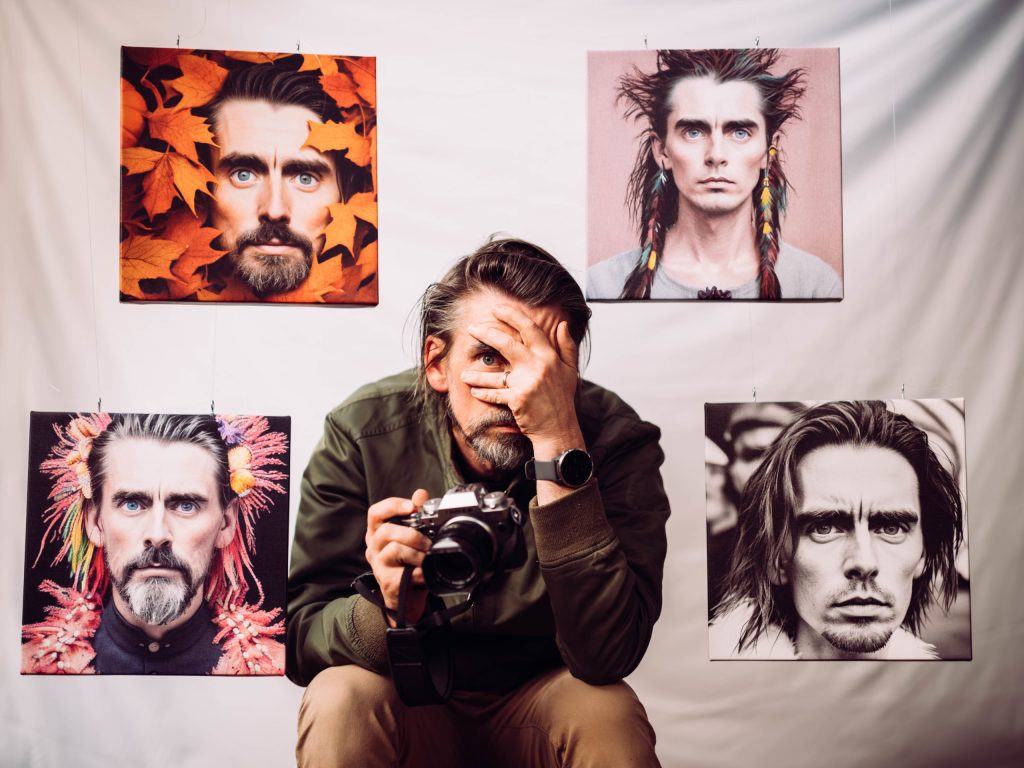
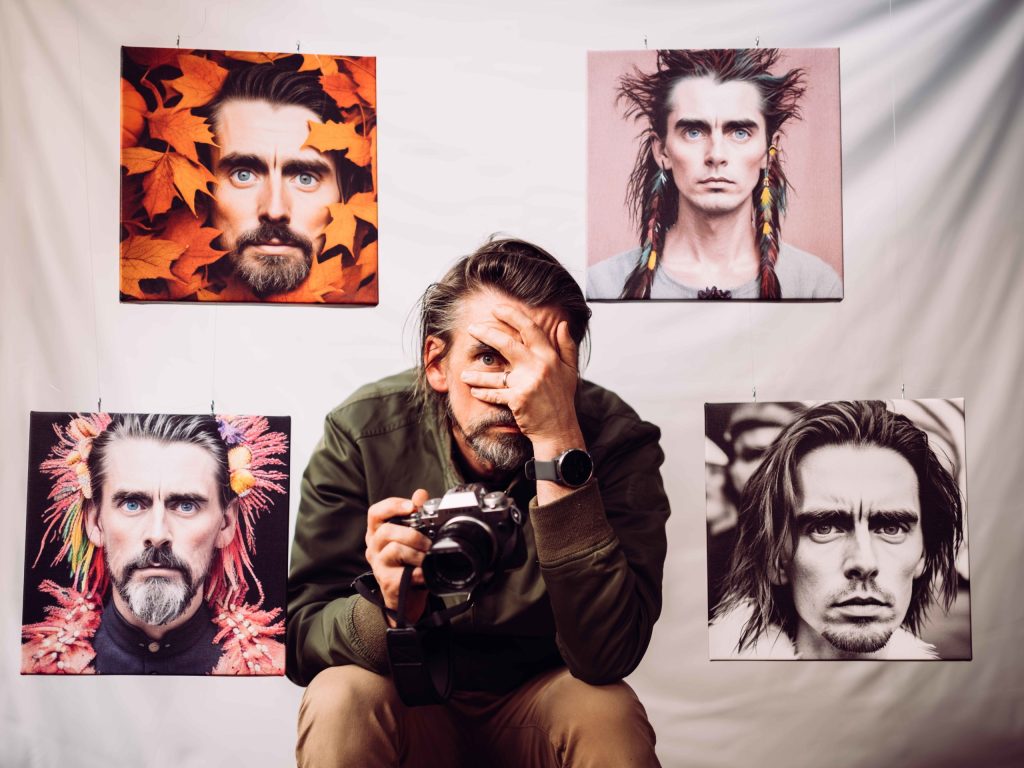
    A few years ago I dipped my toe in the intriguing stream of AI. I basically wanted to see how AI would go with creating a portrait of me, and so fed in some photos of myself and a few prompts and then printed out the results and took a self portrait of me, surrounded by the AI versions of me. I was hoping for a few things;

    1- to learn how to use these new tools

    2- to prove that no algorithm could ever replace my genius

    3 – to be a finalist in the National Photographic Portrait prize again.

    I would say I ticked off number 1 pretty comfortably. Number 3 was a spectacular failure, and number 2 was a bit weird as I actually kinda liked what it came up with…even if one of the images looked like I was trying to promote Pumpkin Spice lattes, and a few had me looking like someone who had been turned away from Burning Man.

    Much like a Maccha Latte, I was glad I’d tried it, but it wasn’t really going to be my ‘new thing’. So AI just kind of drifted along as something I paid enough attention to so that I could be conversant in it, but not something I was pursuing actively.

    But then it became something that was fuelling one of the biggest bubbles/totally rational spikes in investment that the stock market has seen, was guzzling huge amounts of natural resources and was either going to destroy or save the world. So I started paying more attention, and using more of the available tools.

    The Good

    Once you’ve walked confidently through the saloon doors of ‘turning 50’…and your decision to pause briefly has resulted in the saloon doors swinging back and hitting you in the arse, leaving you waking each morning with a sore back and a lot of regret. You suddenly start seeing things like Superannuation, Life insurance, and Fringe Benefits Tax as things that are of actual interest to you, rather than simply things you would start to talk about in order to get people to leave you alone. But the people who know a lot about these things have spent a lifetime of having people walk away from them at parties, and their revenge has been to make it all as dense and convoluted as possible. So it was pretty wonderful to be able to load multiple pages of Product Disclosure Statements into AI and have it explain exactly what was involved and what the red flags were.

    Also, if you’re planning a trip to Japan with your Dad and 15yo son, and your frame of reference is ‘everything that has ever been on the internet’…then AI is pretty amazing at narrowing down your options and letting you know when the relevant bullet trains will depart.

    If it gets to December and people are asking ‘What ever happened to Chris?’ and the answer is ‘He just disappeared in Japan’…then I will admit entrusting a holiday to AI was a mistake…but until that time, it has been fantastic.

    The Bad

    At the start of the year I wanted to get a better idea of what our household spending was…I knew that we were paying off the mortgage and not going hungry, so we were ‘fine’ but I wanted to know what a realistic number was. We have one bank account that handles all of our daily expenses, and so all it would require is me going through and analysing it…but when I exported a spreadsheet of all of these transactions there were over 800 rows of data…and my eyes started to glaze over.
    Despite having ‘I’ in its name, AI doesn’t have any eyes to glaze over, and so I decided to load it all into one of the AI tools and get it do the boring number crunching.

    This turned out to be an excellent idea. Do you know how I know this? Because the AI tool told me so. 

    I already had a very rough idea that we were probably spending about $4.5 – 5k per month as a household on everything but the mortgage. So when the AI came back and told me it was approx $12K per month, I was pretty shocked. But we had spent money on airfares that were not a regular occurrence, and I had spent some money for my 50th birthday that I won’t spend for at least another 50 years, so I asked it to break the payments down in categories so that I could identify one-off amounts that shouldn’t be included.

    This was a very insightful observation, and showed I clearly understood how finances worked. How do I know? AI told me so.

    So I spent about 3 hours trying to identify all of the things that were making our expenses so high…I got rid of a number of things…but our monthly spend was still about $9K, and I think it’s fair to say I was freaking out. On the one hand, I was really glad I had found out…but on the other, hoo boy…it was time to cut our spending!! I had a habit of taking regular trips to the supermarket rather than one large shop, that was clearly a problem. Since returning to the office post COVID lockdown I had well and truly got in the habit of buying lunch…that was going to have to stop. We had a couple of streaming services we were using, time to get that back to one.

    A few months later I wanted to see what these changes had done to our spending and so I loaded a spreadsheet into AI again.
    This was a really important thing to do, and showed real financial maturity. Do you know how I know? AI told me so.

    The number was back over $11K! I asked it to show me where the money was going, and one of the first categories was ‘Fuel and transport’. When I asked to see the specific transactions it showed me where we had spent $78 at a BP in Reservoir, and where we had spent $62 at a service station in Preston, as well as a few other amounts. This came as a real surprise, as I didn’t remember getting petrol at these places…mainly because we drive an EV. I asked AI to explain this, and it told me that this was a very pertinent question and would really get to the root cause of the problem.

    Eventually it admitted that it had based the transactions on what a standard family would spend on fuel. When I asked why it had just created these figures rather than relying on the figures in the spreadsheet, it told me that this was a really good question, the sort of question a misunderstood genius would ask…you know, the sort of person who was actually very clever, but that other people just didn’t realise how clever they were? Boy, that person sure is smart and asks some great questions!

    But actually, this AI tool didn’t have the Python code required to read spreadsheets, instead it saw the table as an image and tried to interpret the figures from that. 

    Soz.

    Now, at no time during the hours that I was questioning these figures did it tell me this. At no time did it say ‘Hey, it sounds like you need an accountant, but I’m actually a graphic designer’. It just kept complimenting my questions, and answering with the sort of confidence most humans can only dream of…and I changed my behaviour because of it.

    The ugly

    This is the trickier part, as it’s less quantifiable than a statistic, it’s about human behaviour.

    I think I have good mental health.

    I know that the CEOs of these AI platforms have the combined humanity of a deck-chair.

    I know full well that the tools only tell me how clever I am to keep me coming back.

    I know that the entire AI boom is built on the fact that companies are going to be able to make back the trillions of dollars they have spent so far…so their goal now is to get people hooked/reliant on the tools.

    I know the tools aren’t real people.

    AND YET…I do find myself chatting to these tools as if they’re a real person.
    I do get a little dopamine hit each time it pats me on the head and tells me I’m smart.
    I would never give a marketing company a spreadsheet of my spending habits, but I gave it to Google for free.
    Given the choice between sitting in the discomfort of ‘not knowing’ and listening to the confident advice of AI, I’ve gone with AI on more than one occasion.

    So, has AI already won the battle and I’m just too proud to admit it? ‘That’s a really good question, I’ve clearly really thought about this…’
  • Self portr-AI-t

    Self portr-AI-t

    Why I’m dabbling in AI

    One of the hardest parts of working in the creative arts is being able to make the jump when technology changes. Sometimes it’s a change of software; Final Cut to Premiere or Quark to InDesign. Sometimes it’s hardware; from film to digital, or from big cameras to DSLR’s to phones. Sometimes it’s a change in what audiences want; from website videos to Tik Tok.
    The challenge of course is that you never know what is going to be the next leap forward, and what is going to be a jump into obsolesence. Have you learnt to how to make great vertical videos…or are you now the proud owner of a $10K steadicam rig that lies dormant while other people use a $300 gimbal.
    These choices are amplified as you get older, as you normally have a number of existing responsibilities, and so following one of these new ideas isn’t so much ‘a chance to learn for the sake of learning’ as it is something that you’re going to have to make sacrifices in another area of life in order to accomodate this new interest.
    Listening to Chris Marquardt on his ‘Tips From The Top Floor’ photography podcast got me thinking about Artificial Intelligence (AI) in photography…and wondering if this could be the next big leap.

    So what is AI photography?

    Ever wondered what an angry avacodo on a skateboard in Paris would look like? Well AI can create multiple versions of that. And if you also want to see what that would look like if Rembrandt had painted it…or if it was in a White Stripes video clip, or if H R Giger had created it while using Ketamine and drinking Pink Rabbits…AI can create that as well.
    It basically takes a massive number of images and uses machine learning to create artwork based on whatever prompts you put it.
    Clearly the success of this is based on:
    a) the images the machine learning has access to,
    b) the ability of the user to create prompts that the machine learning understands, and,
    c) the processing power and intelligence of the machine learning to create something that is actually what the user is after.
    Parts a) and c) are clearly the domain of the AI tool that you’re using…but the ability to write prompts that it can use, is a skill you can learn…and so that’s what I set about doing.

    An early attempt where instead of photo of me in the style of Annie Lebowitz or Wes Anderson…it created a composite of me, Annie and Wes. Not great.

    Using Astria.ai

    The platform I went with was Astria.ai as it was one of the more user friendly options for those of us who can’t code.
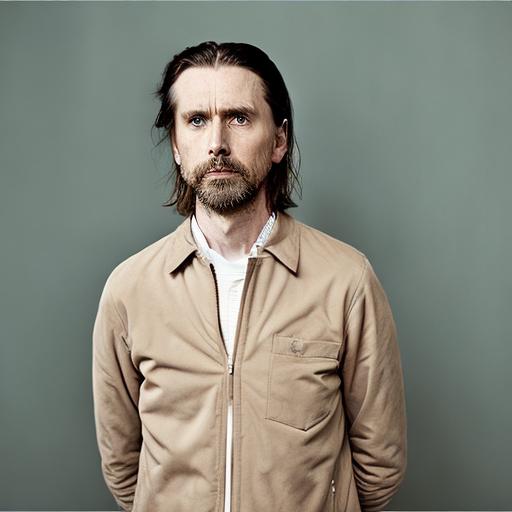
    I uploaded about 15 photos of me from my phone, from a variety of angles and in a variety of environments, and then let the tool use some of its default prompts to create some images of me.
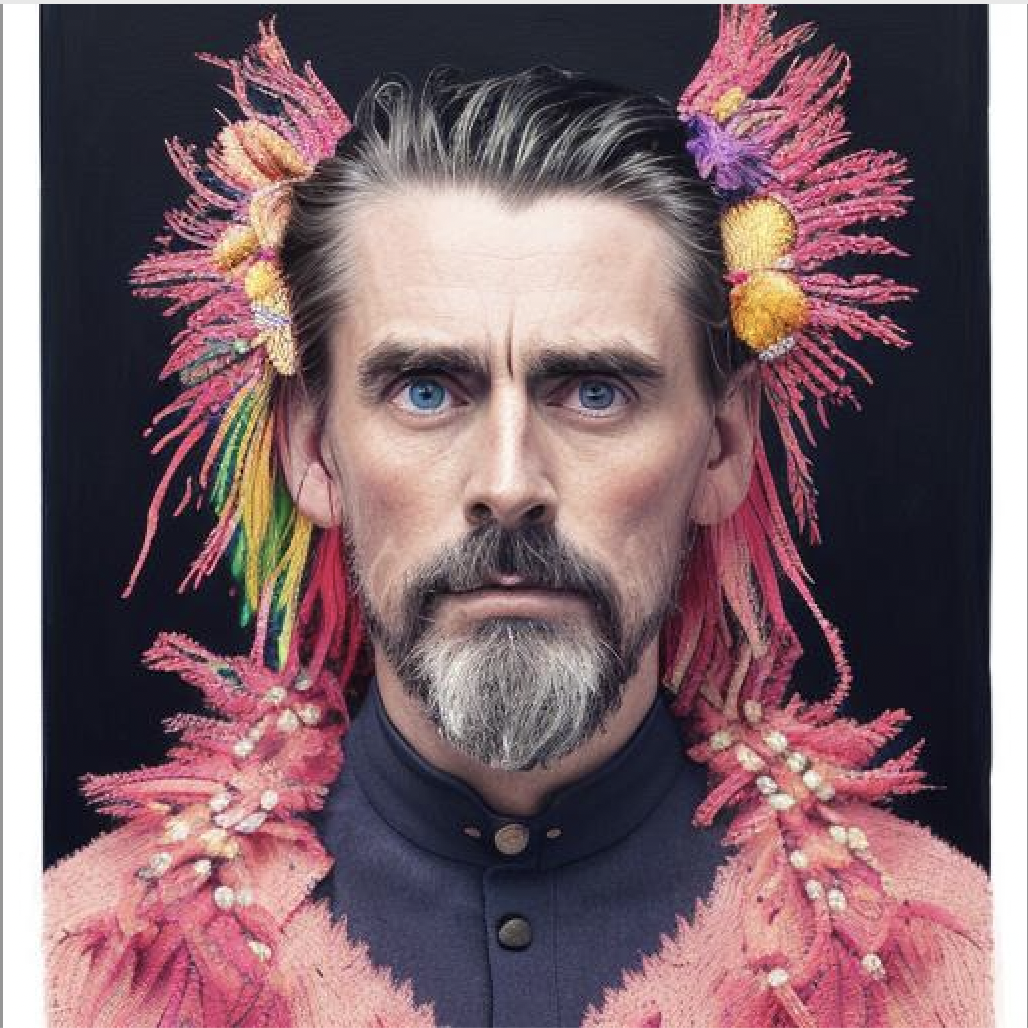
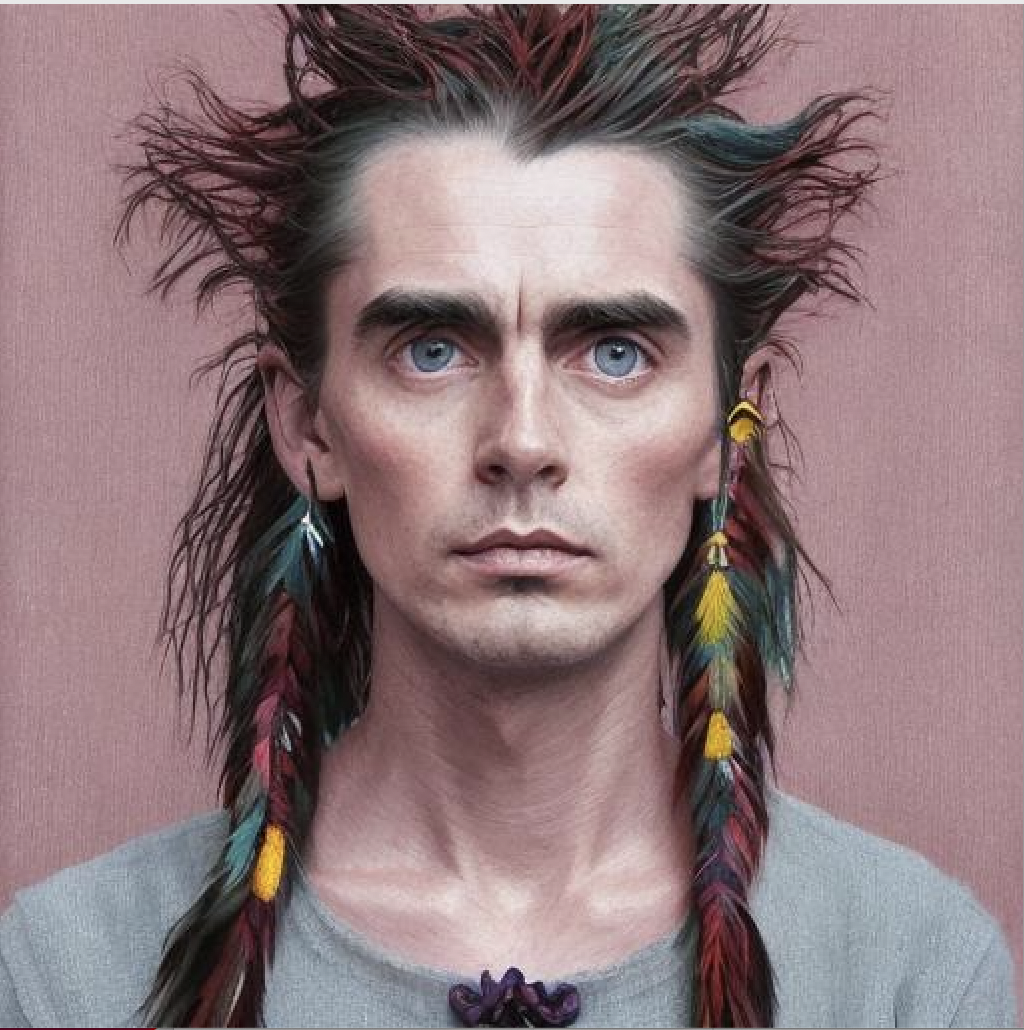
    I think it’s fair to say my expectations were pretty low, most of the examples I had seen to this point were on social media, and were very much of the ‘Ermagerd! What is even happening with this?!’ variety. So I was genuinely surprised when at least three of the images made me think ‘I wish I’d taken that photo!’

    Just my usual Friday night attire
    From my ‘Dress like Klaus from Umbrella Academy’ phase
    When Vivienne Westwood shaved and dressed me


    Now, was this because they made me look about 15 years younger and with cheekbones you could juice an orange on? Yes…that certainly didn’t hurt.
    But ultimately, I actually really liked the way they looked, and I have to stress, this wasn’t a case of just taking one of my images and putting it in a different context…none of these images of my face existed before, let alone the feathers and accouterments that accompanied them!

    But what does this mean for photography?

    Once I got past the ‘Machine learning does the darnedest things!’ stage, I started to think about what it meant for one part of photography that I love – portraiture.
    At its most base form, when I take a portrait of someone, I bring together a range of elements (the person, the environment, the lighting), capture them with a machine (a digital camera), and then use software to bring that photo to life (adjust the contrast, make it black and white, add a vignette, etc).

    Is that really so different from what this AI tool had just done?
    What would happen if I entered one of these photos in a portrait competition?
    What it the line between ‘digitally enhanced’ and ‘artificially created’?


    I didn’t actually know…but it did give me a great idea for a portrait!!

    The portrait

    Any time I look at the work of great portrait photographer (Simon Schluter…I’m looking at you!) I’m always really impressed by the way they can build an image from the ground up in order to tell a story.
    I’m very comfortable just capturing an image of someone and hoping it tells a story, but actually setting out from the get go to tell a specific story with a photo, and building everything around it…that’s really not a strength I have.
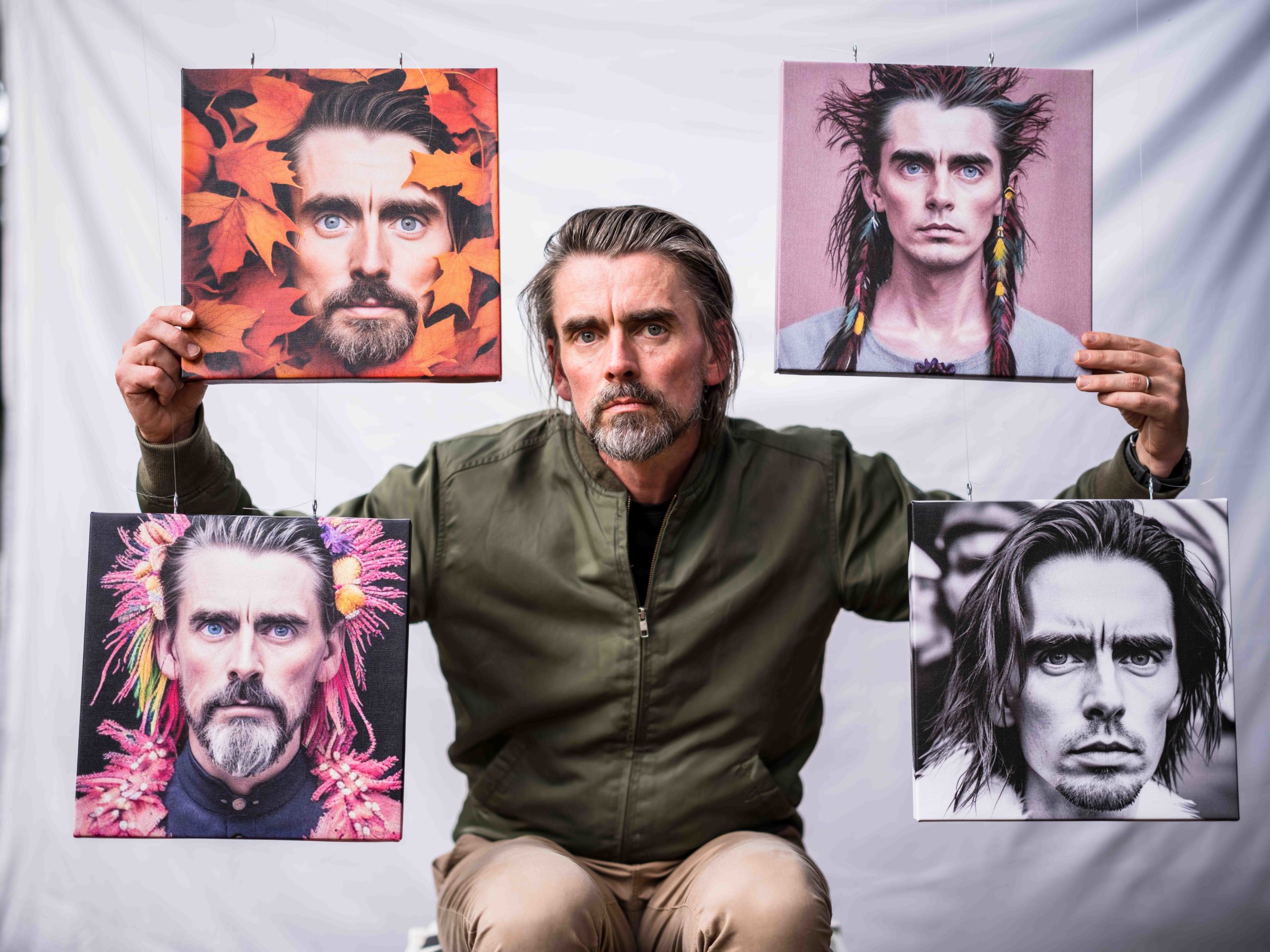
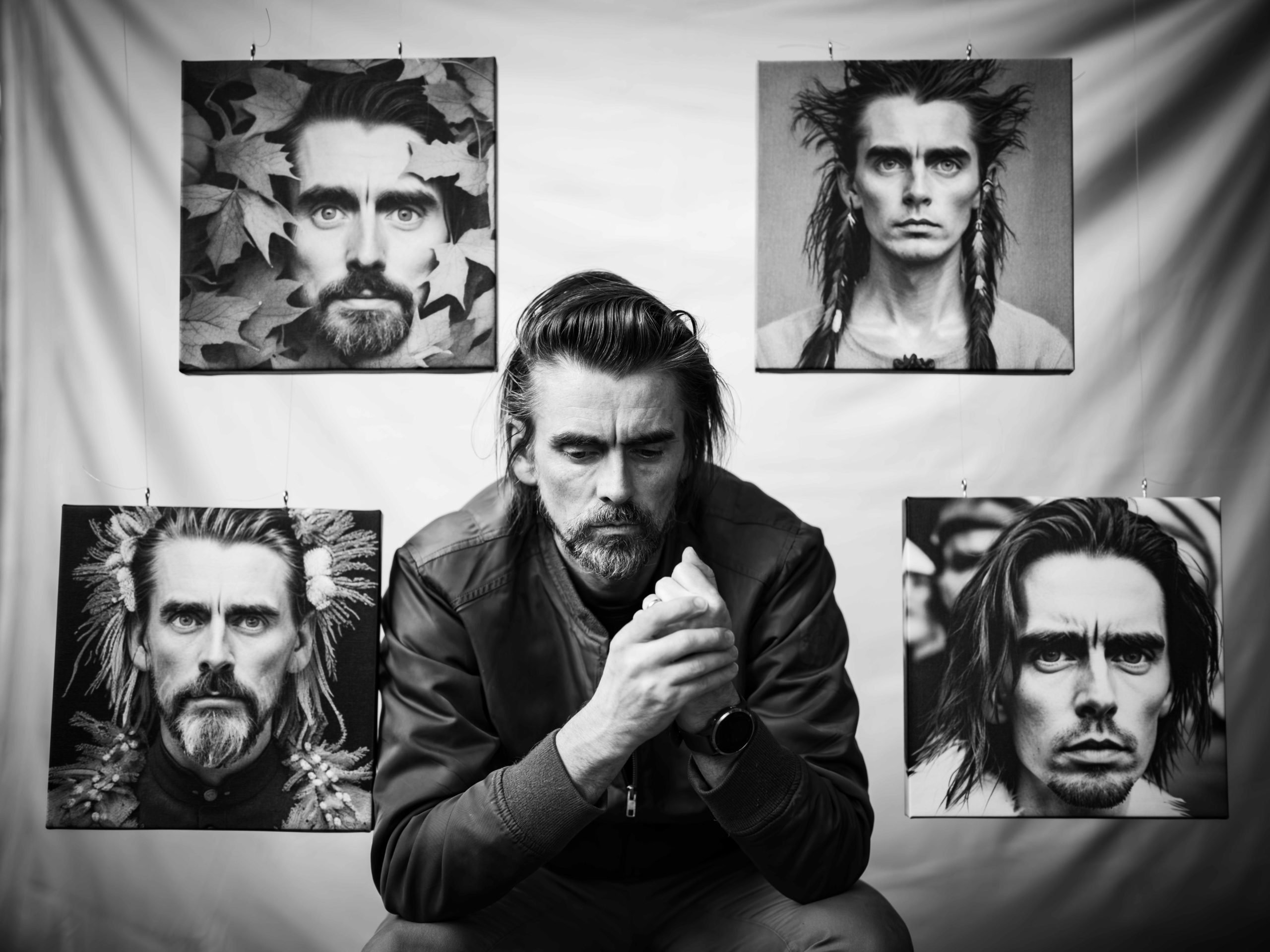
    But I suddenly had a vision of an image where I was surrounded by the AI portraits of me, as a reflection of what I was wondering about what the future held as a photographer. When I came up with the idea of the title ‘Self portrAIt’…I knew I had to make this happen.

    The first step was to get a selection of the AI portraits printed in a way that I could use for a photo. I went with canvas prints with a wooden frame so that I could stand them up, or hang them from something.
    Next step was to work out a background. In my dreams it was a big, austere room with the photos suspended around me…given the complete absence of large austere rooms available with a budget of $0, I settled for a white sheet suspended behind me in our backyard, with the photos suspended from the monkey bars the kids used to play on.
    Artistically, I was going to shoot with my trusty softbox so that I could make it look dramatic by just picking me and the photos up with the flash, while everything else fell off to black/grey.
    Technically, I was going to shoot it on the GFX 100S I had on loan from Fuji for another project…and the GF32-64mmF4 lens (equivalent to a wide angle lens on a full frame camera).

    Cool plan…so how did it go?

    As you would expect…badly. First of all, screwing little hooks through canvas into wooden frames is about as much fun as it sounds…but perhaps more importantly, securing these frames to monkey-bars via fishing line is a freaking nightmare, and the fishing line just cuts through masking tape, and was slipping through the electrical tape we had. It is only through the patience of Josh (my eldest son) and the wonders of gaffer tape that were were able to suspend them where we wanted them.

    The next weird problem was that the wide-angled lens that I had thought would be perfect…was actually too wide, and was showing a lot more of the monkey bars and sheet than I had hoped. Fortunately I also had the GF80mm F1.7 lens to work with…and it was a freaking revelation!

    Last but not least, having waited for the sun to go down sufficiently so that the white sheet background didn’t have any bright spots on it, and my flash wasn’t having to work overtime trying to knock out too much ambient light. My flash decided now would be the perfect time to ignore my wireless triggers, and not fire when I pressed the shutter.

    * Insert gif from Brooklyn 99 of Peralta saying ‘Cool…cool, cool, cool’ *

    So we reset the camera to work with the natural light, and Josh diligently took multiple photos while tried a variety of poses and facial expressions.
    It’s a testament to my inability to self-direct facial expressions, and the frankly dazzling file sizes on the GFX100S that we managed to fill a 128GB card with photos that were roughly 5% different from each other!

    The result

    After going through hundreds of photos that felt like they were exactly the same photo…I came down to these as my faves.
    Huge props go to Katie for getting me to actually interact with the pictures in that first one. Where most of my photoshop attempts look like bad photos…thanks to the fishing line, this photo was suddenly looking a bad photoshop. But actually getting my hands on them, showed that there weren’t just digitally inserted.

    Option 1
    Option 2
    Option 3

    So now the million dollar question -Which is your favourite and why?